fbpx

A.U.R.A.

A.U.R.A. SIGNATURE PROGRAMME​

A.U.R.A. (Awareness, Understanding, Resilience, Awareness) is an internationally accredited mindfulness programme designed to cultivate self-awareness, emotional resilience, inner balance, and aligned living. It provides learners with a strong foundation in mindfulness while also creating a clear pathway for those who wish to progress toward professional mindfulness facilitation and teacher development.

1) Personal Development Track

This category is for students who:

  • Wish to undertake the programme for personal development, wellbeing, or general
    knowledge
  • Are not seeking professional recognition or registry listing

Outcome:

  • Students will receive an APEX ED – UMV joint certification upon completion
  • This certification will reflect successful completion of the programme but is not intended as
    a professional accreditation pathway

2) Professional Track

This category is for students who:

  • Intend to pursue mindfulness teaching professionally
  • Aim to meet international standards
  • And wish to progress toward IMTA certification and registry listing

Personal Development Track

For learners seeking mindfulness knowledge,
wellbeing, and self-development.

Professional Track

For learners seeking professional development,
and progression toward the IMTA registry.

The Personal Development Track provides learners with a structured introduction to mindfulness as a tool for personal wellbeing, emotional awareness, and reflective living. It is ideal for individuals who wish to experience the benefits of mindfulness in their personal or professional lives.

Upon completion, learners will be awarded the APEX ED / UMV Joint Certification.

The 12 week programme consists of an 8 week theory component teaching core MBSR modules, retreats and guided practice

Week Theme Core Focus
Week 1 Introduction to Mindfulness Present-moment awareness, body scan, beginning formal practice
Week 2 Perception and Awareness How perception shapes stress, automatic reactions, mindful noticing
Week 3 Mindfulness of the Body Mindful movement, breath awareness, body-based practice
Week 4 Stress and Reactivity Understanding stress patterns, reacting vs responding
Week 5 Working with Difficulty Awareness of thoughts, emotions, discomfort, and habitual responses
Week 6 Mindful Communication Interpersonal mindfulness, listening, speaking, and relational awareness
Retreat / Practice Day Guided Retreat Practice Extended silent/guided practice, body scan, sitting meditation, mindful movement, walking meditation
Week 7 Integrating Mindfulness Applying mindfulness to daily life, work, relationships, and wellbeing
Week 8 Continuing the Practice Review, reflection, sustaining practice beyond the course

The 12 week programme consists of an 8 week theory component teaching core MBSR modules, retreats and guided practice

Theme:

Introduction to Mindfulness

Core Focus:

Present-moment awareness, body scan, beginning formal practice

Theme:

Perception and Awareness

Core Focus:

How perception shapes stress, automatic reactions, mindful noticing

Theme:

Mindfulness of the Body

Core Focus:

Mindful movement, breath awareness, body-based practice

Theme:

Stress and Reactivity

Core Focus:

Understanding stress patterns, reacting vs responding

Theme:

Working with Difficulty

Core Focus:

Awareness of thoughts, emotions, discomfort, and habitual responses

Theme:

Mindful Communication

Core Focus:

Interpersonal mindfulness, listening, speaking, and relational awareness

Theme:

Guided Retreat Practice

Core Focus:

Extended silent/guided practice, body scan, sitting meditation, mindful movement, walking meditation

Theme:

Integrating Mindfulness

Core Focus:

Applying mindfulness to daily life, work, relationships, and wellbeing

Theme:

Continuing the Practice

Core Focus:

Review, reflection, sustaining practice beyond the course

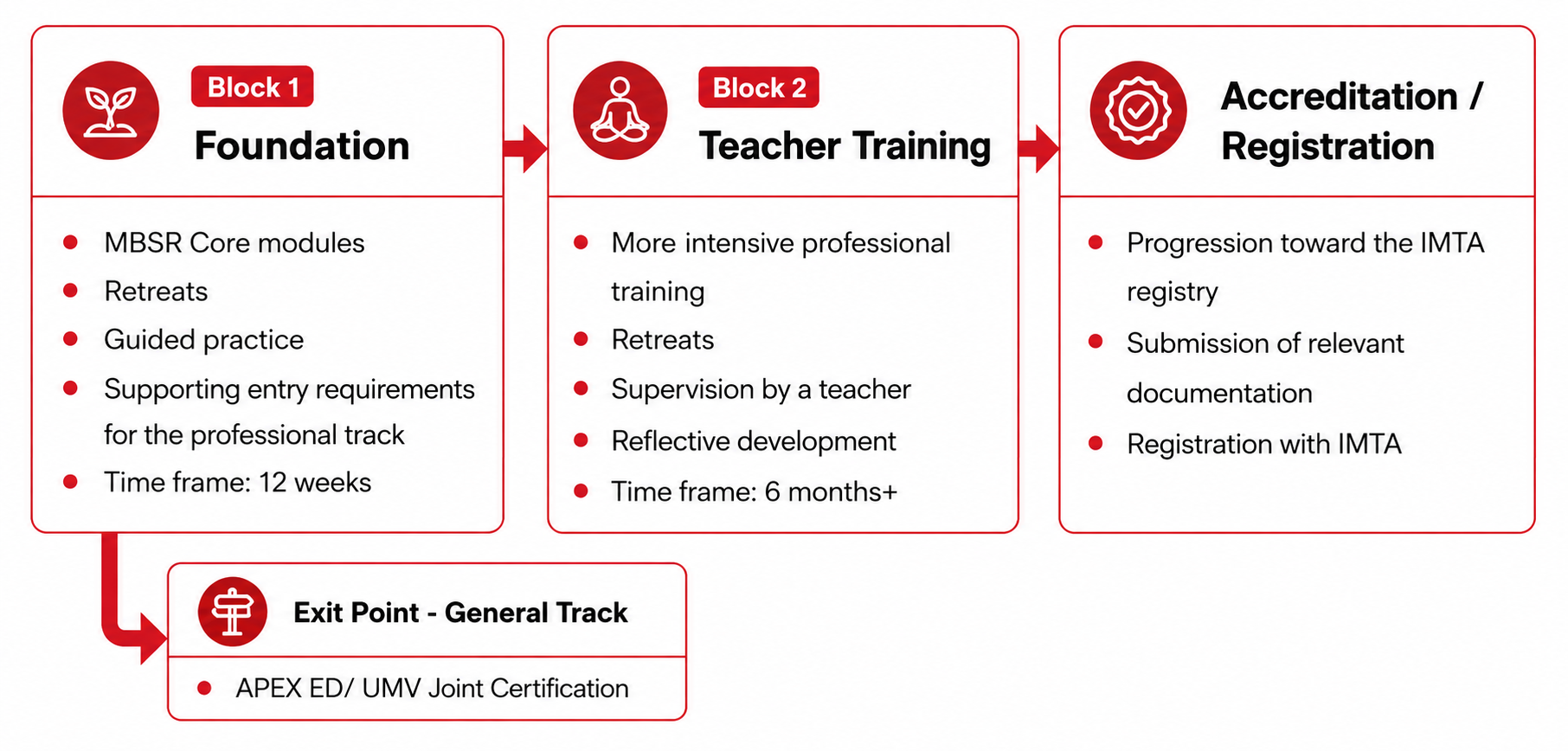
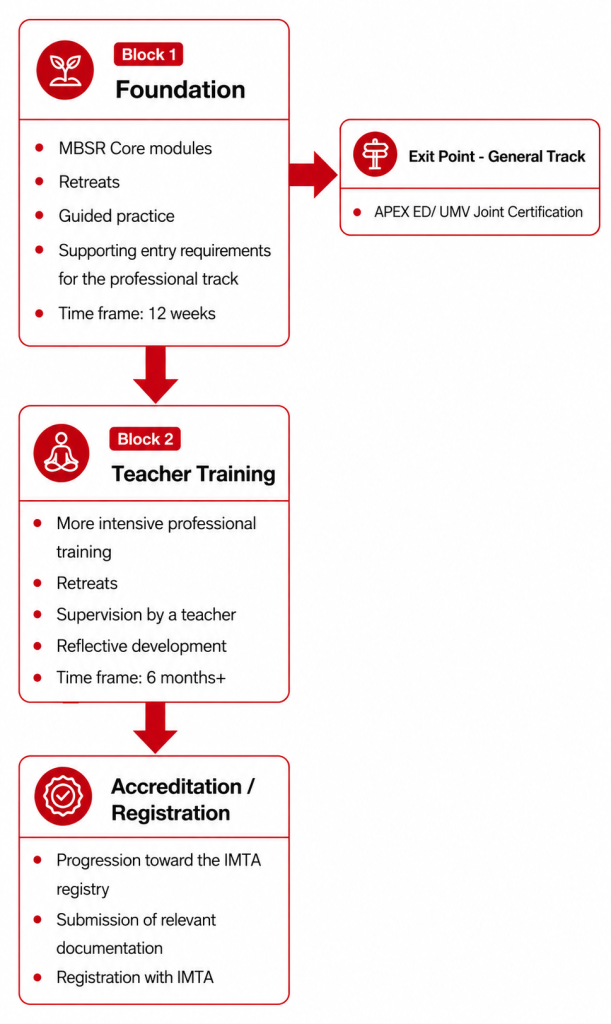
The professional track follows a structured pathway for learners who wish to move toward becoming a professionally recognised mindfulness teacher. The journey begins with the Block 1 foundation, progresses into teacher training with supervised development and practice, and then moves into the accreditation / registration stage. The programme is aligned to the IMTA (International Mindfulness Teachers Association) pathway, with IMTA serving as the external accreditation and professional progression route.

Teacher Training Competency Area Subjects Minimum Contact Hours
Required Contact (Classroom) Hours
Mindfulness Studies
  • Overview of the mindfulness field
  • History of mindfulness
  • Science of Mindfulness
  • Secularization of mindfulness
  • Complementary practices (eg. cultivation of positive emotions, relational mindfulness, inquiry, working with trauma etc.)
40
Personal Practice Maturation & Development
  • Ongoing mindfulness practice in group setting with instruction and community support
  • Personal exploration work of relevant issues to mindfulness facilitators such as presence and embodiment, cultivation of confidence
25
Teaching Methodology, Training and Supervision
  • Community building practices
  • Mentorship and Supervision
  • Feedback and peer support for facilitation practice
  • Group facilitation skills
  • Working with conflict in groups
  • Working with individuals
50
Contemporary Mindfulness Applications Exploration of practical applications of mindfulness in any of the following areas or related others:
  • Education and youth
  • Academia
  • Workplace/business settings
  • Medicine
  • Psychology/Clinical Applications
10
Cultural Competency
  • Diversity issues in the mindfulness field
  • Working with diverse populations, cross-cultural issues
  • Professional Ethics for Teachers
  • Accessibility of language, and presentation, removing barriers
20
Professional Development
  • Bringing mindfulness into institutions
  • Financial issues in mindfulness facilitation as a career path
  • Marketing
  • Creating livelihood
  • Networking
20
Required Non-Contact (Non-Classroom) Hours
Practicum / Field Work This component requires students to actively facilitate mindfulness in their work or volunteer setting 35
TOTAL REQUIRED HOURS 200

Subjects:

  • Overview of the mindfulness field
  • History of mindfulness
  • Science of Mindfulness
  • Secularization of mindfulness
  • Complementary practices (eg. cultivation of positive emotions, relational mindfulness, inquiry, working with trauma etc.)

Minimum Contact Hours:

40

Subjects:

  • Ongoing mindfulness practice in group setting with instruction and community support
  • Personal exploration work of relevant issues to mindfulness facilitators such as presence and embodiment, cultivation of confidence

Minimum Contact Hours:

40

Subjects:

  • Community building practices
  • Mentorship and Supervision
  • Feedback and peer support for facilitation practice
  • Group facilitation skills
  • Working with conflict in groups
  • Working with individuals

Minimum Contact Hours:

50

Subjects:

Exploration of practical applications of mindfulness in any of the following areas or related others:

  • Education and youth
  • Academia
  • Workplace/business settings
  • Medicine
  • Psychology/Clinical Applications

Minimum Contact Hours:

10

Subjects:

  • Diversity issues in the mindfulness field
  • Working with diverse populations, cross-cultural issues
  • Professional Ethics for Teachers
  • Accessibility of language, and presentation, removing barriers

Minimum Contact Hours:

20

Subjects:

  • Bringing mindfulness into institutions
  • Financial issues in mindfulness facilitation as a career path
  • Marketing
  • Creating livelihood
  • Networking

Minimum Contact Hours:

20

Subjects:

This component requires students to actively facilitate mindfulness in their work or volunteer setting

Minimum Contact Hours:

35


TOTAL REQUIRED HOURS:
200

IMTA ALIGNED PROFESSIONAL MINDFULNESS PATHWAY

The International Mindfulness Teachers Association (IMTA) is a respected international mindfulness body based in the US dedicated to setting the highest standards for mindfulness educators and trainers worldwide. The IMTA serves as a central hub and community for mindfulness professionals worldwide working to oversee national and international mindfulness teacher education standards to ensure a level of depth and rigour that benefits both teachers and students.

Why IMTA?
• Internationally recognised professional pathway
• Access to a global professional mindfulness community
• Strong standards for training and progression
• A credible structure for future professional practice

The IMTA Registry / Certified Teachers Directory places teachers within a wider international professional mindfulness community. IMTA certification is presented as a way to gain an internationally recognised credential, increase credibility and trust, connect with a network of experienced mindfulness professionals, and become more visible to potential students and professional opportunities through the IMTA Certified Teachers Directory. The registry is positioned as both a professional showcase and an entry point into a broader global ecosystem of recognised teachers, accredited centres, and ongoing professional development. 

To get listed, the individual must complete IMTA teacher certification. The core requirements are: 

  • Completion of training through an IMTA Accredited Mindfulness Teacher Training Program, or through the Alternate Pathway if the training was not IMTA-accredited 
  • Completion of at least one mindfulness meditation retreat of minimum 5 days with a qualified instructor 
  • Completion of a mindfulness course such as MBSR, MAPs, or equivalent 
  • Submission of documentation, including:
    – Name of training programme attended
    – Dates attended
    – Teacher names
    – Copy of graduation certificate
    – Certification fee payment 

Students who go on to complete the IMTA professional credential gain:

  • Public listing in the IMTA Certified Teachers Directory
  • Stronger professional credibility and visibility
  • Improved marketability to students, organisations, and wellbeing partners
  • Clearer progression into recognised professional mindfulness teaching

Graduates of this pathway are most likely to find opportunities in:

  • Corporate wellbeing and workplace resilience
  • Education and schools
  • Community and NGO programmes
  • Private wellbeing, coaching, and group facilitation
  • Public-service and third-sector wellbeing initiatives

This pathway is not presented primarily as a direct route into NHS employment.

Accepted students should have:

Either

  • A minimum 2 years of regular mindfulness meditation practice
  • Attended at least 1 mindfulness meditation retreat of a minimum of 5 days with a qualified instructor. More than 1 retreat is highly recommended
  • Attended a mindfulness course like Mindfulness Based Stress Reduction (MBSR), Mindful Awareness Practices (MAPs) or equivalent

Or

  • A minimum 2 years of regular mindfulness meditation practice
  • And completion of Block 1 of our programme A.U.R.A.