Important distinction
This policy deals with complaints about APEX ED services, actions, omissions, staff conduct and the student experience. Challenges to assessment, progression or other academic decisions are normally considered under the separate Academic Appeals Policy. Admissions matters are handled through the separate Admissions Complaints & Appeals Procedure.
APEX ED is committed to providing a high-quality student experience and to responding fairly, promptly and constructively when a student is dissatisfied. This Policy explains how students can raise concerns and complaints, how APEX ED will consider them, and how outcomes will be communicated.
The purpose of the procedure is to resolve concerns as early as reasonably possible, provide a fair route for formal investigation where needed, and ensure that lessons from complaints are used to improve services and the student experience.
A student will not be disadvantaged because they have raised a genuine concern or complaint in good faith.
This Policy applies to current APEX ED students and to students who have recently completed, withdrawn from, or otherwise left a programme, where the complaint relates to matters arising during their period of study or engagement with APEX ED.
It applies to services provided directly by APEX ED and, where appropriate, to services delivered on APEX ED’s behalf. Complaints may concern an individual incident, a continuing issue, or a series of related events.
Where another organisation has responsibility for all or part of the matter, APEX ED will explain the appropriate route and, where appropriate and permitted, assist the student to access it.
For the purposes of this Policy, a student complaint is an expression of dissatisfaction by one or more students about something APEX ED has done or not done, or about the standard of a service provided by or on behalf of APEX ED.
Examples may include concerns about:
Some concerns are better considered under a different procedure. APEX ED will not reject a concern merely because the student has used the wrong label; it will explain the appropriate process and, where practicable, route the matter accordingly.
The following are not normally determined under this Student Complaints Policy:
Where issues overlap more than one procedure, APEX ED will consider the most appropriate and proportionate way to handle them. Procedures may be run sequentially, in parallel, or adapted where this is fair and practical. The student will be told how the matter will be managed.
APEX ED will apply this Policy in accordance with the following principles:
Accessible and clear: Information about how to complain will be easy to find and written in clear language. Reasonable alternative formats or adjustments will be provided where needed.
Fair and independent: Students and relevant staff will have a fair opportunity to provide information. Formal and review-stage decisions will be made by people who are appropriately independent of the matter and free from conflicts of interest.
Confidential: Information will be shared only as far as reasonably necessary to investigate, decide and respond to the complaint, subject to legal, safeguarding and procedural requirements.
Inclusive: APEX ED will seek to identify and reduce barriers to using the procedure and will make reasonable adjustments where appropriate.
Proportionate and timely: The level of investigation will reflect the seriousness and complexity of the issues. Complaints will be progressed without unnecessary delay.
Reasoned and transparent: Written decisions will explain the outcome and the key reasons for it, together with any further internal step available.
Improvement-focused: Complaint information will be used, where appropriate, to identify patterns, improve services and reduce recurrence.
APEX ED will apply this Policy in accordance with the following principles:
Accessible and clear: Information about how to complain will be easy to find and written in clear language. Reasonable alternative formats or adjustments will be provided where needed.
Fair and independent: Students and relevant staff will have a fair opportunity to provide information. Formal and review-stage decisions will be made by people who are appropriately independent of the matter and free from conflicts of interest.
Confidential: Information will be shared only as far as reasonably necessary to investigate, decide and respond to the complaint, subject to legal, safeguarding and procedural requirements.
Inclusive: APEX ED will seek to identify and reduce barriers to using the procedure and will make reasonable adjustments where appropriate.
Proportionate and timely: The level of investigation will reflect the seriousness and complexity of the issues. Complaints will be progressed without unnecessary delay.
Reasoned and transparent: Written decisions will explain the outcome and the key reasons for it, together with any further internal step available.
Improvement-focused: Complaint information will be used, where appropriate, to identify patterns, improve services and reduce recurrence.
A complaint may be made by an individual student or by a group of students affected by the same or closely related issues.
A former student may use this procedure where the complaint concerns their experience while enrolled or registered with APEX ED and is raised within the normal time limits, subject to reasonable flexibility where there is good reason for delay.
6.1 Representatives and supporters
Students may seek advice, support or representation from another person. APEX ED may ask the student to provide clear written consent before discussing the complaint or personal information with a representative. The appointment of a representative should not normally delay the process.
APEX ED may set reasonable arrangements for meetings or correspondence involving representatives, while remaining flexible where adjustment is necessary to avoid disadvantaging a student.
6.2 Group complaints
Where the same issue affects more than one student, APEX ED will permit a group complaint. The group may be asked to nominate one representative for communication purposes and each student may be asked to confirm that they wish to participate.
Where members of a group have been affected differently, APEX ED may consider individual remedies separately or divide the complaint into appropriate sub-groups. A student who does not wish to participate in a group complaint may raise their own complaint.
6.3 Anonymous concerns
Students are encouraged to identify themselves so that APEX ED can investigate fully, communicate with them, and provide an individual outcome. APEX ED may nevertheless consider an anonymous concern where there is a good reason to do so, including where the information raises safeguarding, safety, serious misconduct or wider systemic concerns.
Anonymous reporting may limit the investigation, the information that can be tested, and the individual response or remedy that APEX ED can provide.
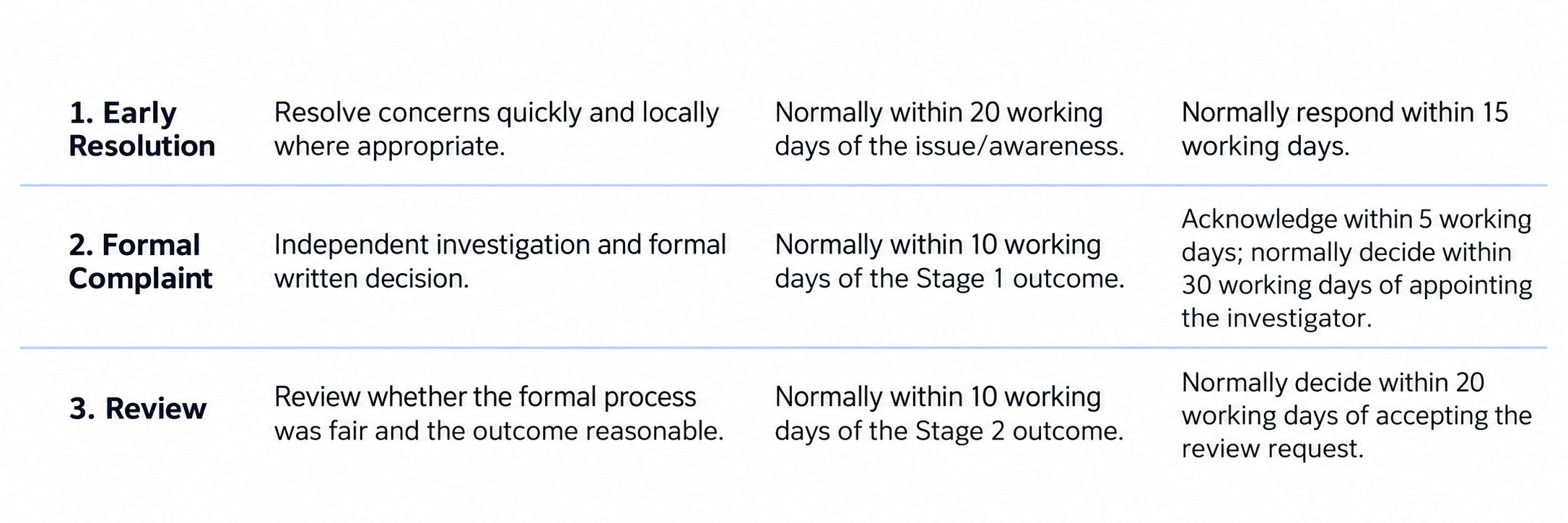
A student should normally raise a complaint at Stage 1 within 20 working days of the event, issue or circumstances giving rise to the complaint, or within 20 working days of when the student could reasonably have become aware of it.
APEX ED may accept a complaint outside this period where there is a good reason for the delay. In deciding whether to do so, APEX ED may consider the seriousness of the matter, the student’s circumstances, whether relevant evidence remains available, and whether it would still be fair and practicable to investigate.
Concerns involving safeguarding, harassment, serious misconduct, safety or other particularly sensitive matters will not be rejected solely because a student did not raise them within the normal period. APEX ED may prioritise a complaint where delay could cause significant prejudice, affect progression or wellbeing, or create an ongoing risk.
The procedure has three stages. Early resolution may be bypassed where the complaint is serious, complex, unsuitable for informal handling, or where there is another good reason to move directly to the formal stage.
APEX ED will aim to complete the formal stage and any review within 90 calendar days from the start of Stage 2. Some cases may take longer for good reason. If a target cannot be met, APEX ED will explain the delay and provide appropriate progress updates.
Students are encouraged, where appropriate, to raise a concern promptly with the relevant programme, academic or administrative team. A concern may be raised orally or in writing, including by email.
Stage 1 is intended to resolve straightforward matters quickly. Depending on the issue, this may involve an explanation, correction of an error, meeting, apology, practical action, mediation or another proportionate response.
APEX ED will normally aim to provide a Stage 1 response within 15 working days. Where proportionate, the outcome will be confirmed in writing. If the issue cannot be resolved at Stage 1, the student will be told how to make a formal complaint.
A student is not required to pursue informal resolution where it would be inappropriate because of the seriousness, sensitivity or complexity of the matter, or where the relationship between those involved makes local resolution unsuitable.
10.1 How to submit
A formal complaint should normally be submitted within 10 working days of the Stage 1 outcome. Where Stage 1 has been bypassed, it should be submitted as soon as reasonably possible and normally within the original 20-working-day period described in section 7.
Formal complaints should be emailed to [email protected] with the subject line “Student Complaint”.
Students who cannot reasonably use email should contact APEX ED so that an accessible alternative submission method can be arranged.
The complaint should, where possible, include:
A complaint will not be rejected simply because it is imperfectly presented. APEX ED may ask the student to clarify issues or provide further information where this is reasonably necessary.
10.2 Initial review and acknowledgement
APEX ED will normally acknowledge a formal complaint within 5 working days. It will consider whether the complaint is within scope, whether another procedure is more appropriate, whether the complaint is sufficiently clear to investigate, and whether any immediate action is needed to protect a student or preserve relevant evidence.
Where APEX ED decides that all or part of the matter should be handled under another procedure, the student will be told the reason and the appropriate next step.
10.3 Investigation
The formal complaint will normally be investigated by a Complaints Officer or other suitably senior person appointed by APEX ED who has not been materially involved in the events complained about and who has no conflict of interest.
The investigator will determine a proportionate method of investigation. This may include reviewing documents and records, obtaining information from relevant staff or other people, meeting with the student, or seeking clarification from those involved.
The student will have a fair opportunity to present their case. Information materially relied upon in reaching a decision will normally be shared with the student where fairness requires it, unless there is a lawful or compelling reason not to disclose it. Where information cannot be shared, APEX ED will explain this where appropriate.
Where the complaint concerns the conduct of a member of staff or another student, APEX ED will take particular care to ensure that the investigator is independent of the situation and that the rights and confidentiality of all involved are respected.
10.4 Formal outcome
APEX ED will normally issue a written Stage 2 outcome within 30 working days of the investigator being appointed. The outcome will state whether the complaint is upheld, partially upheld, not upheld, or cannot reasonably be determined on the information available. It will explain the key reasons for the decision.
Where a complaint is upheld or partially upheld, APEX ED will consider an appropriate and proportionate remedy. Depending on the circumstances, this may include:
The outcome will also explain how the student may request a Stage 3 review and the deadline for doing so.
A student who remains dissatisfied after Stage 2 may request a review within 10 working days of the formal outcome. The review is not normally a fresh investigation of the complaint.
A review may be requested on one or more of the following grounds:
A request for review should identify the ground or grounds relied upon and briefly explain why they apply. Repeating the original complaint without identifying a review ground will not normally be sufficient.
The review will be considered by a senior member of APEX ED, or a Review Panel where appropriate, who was not materially involved in the Stage 2 investigation or decision and who has no conflict of interest.
The reviewer may uphold the Stage 2 outcome, vary it, require further investigation, refer the matter back for reconsideration, or substitute another appropriate outcome where the circumstances justify doing so.
APEX ED will normally issue the Stage 3 decision within 20 working days of accepting the review request. The written decision will explain the outcome and key reasons. This normally marks the end of APEX ED’s internal Student Complaints Procedure.
A complaint may include allegations about the behaviour of a member of staff or another student. If APEX ED has a more appropriate specialist procedure, the matter may be referred to that procedure. Otherwise, the concern may be considered under this Policy.
Where the information raises a safeguarding, health and safety, serious misconduct, criminal, regulatory or other significant risk, APEX ED may take protective or precautionary action and may share information with appropriate internal or external persons or authorities where necessary and lawful.
A student making a complaint does not normally have a right to be told confidential details of any disciplinary action taken against another person. APEX ED will nevertheless explain, as far as reasonably possible, how the complaint itself has been addressed.
Students should provide relevant evidence that is reasonably available to them, but the formal investigation is not limited to material submitted by the student. APEX ED may obtain other relevant information as part of its investigation.
Students are expected to engage reasonably with the process, respond to proportionate requests for clarification or evidence, attend meetings where reasonably necessary, and meet stated deadlines. If a student does not engage, APEX ED may proceed on the information available where it is fair to do so.
APEX ED will not require evidence that is unnecessary or disproportionate to the issue raised.
A complaint can usually be considered on the written information available, but APEX ED may arrange a meeting where this would assist a fair and effective resolution.
Students may be accompanied or represented as described in section 6.1. Meetings are intended to be fair and accessible rather than legalistic. Legal representation is not normally necessary, but APEX ED will consider reasonable requests in exceptional circumstances, taking account of fairness and proportionality.
APEX ED will make reasonable adjustments to the complaints process for disabled students and will consider other accessibility needs. Adjustments may include alternative communication formats, additional time where justified, assistance with submission, or reasonable changes to meeting arrangements.
Complaints will be handled with an appropriate level of confidentiality. Information will normally be shared only with people who need it to investigate, advise on, decide or implement the outcome of the complaint.
A student may ask for particular information to be kept confidential. APEX ED will consider the request carefully but cannot guarantee complete confidentiality where disclosure is reasonably necessary for a fair investigation, to protect another person, to comply with law or regulation, or to address safeguarding or serious risk concerns.
Personal information will be handled in accordance with APEX ED’s Privacy Policy [Link] and applicable data protection law.
Students must be able to raise genuine concerns without fear of disadvantage. APEX ED will not penalise a student merely because they have made a complaint, requested a review, supported another student’s complaint, or provided evidence in good faith.
This protection does not prevent APEX ED from addressing conduct that is abusive, threatening, deliberately dishonest or otherwise falls within an applicable conduct or disciplinary procedure.
APEX ED expects everyone involved in a complaint to communicate respectfully and to engage with the process reasonably. Most complaints will not require any special restrictions on communication.
Where a person’s behaviour becomes abusive, threatening, discriminatory, persistently repetitive without new information, or otherwise makes fair and efficient handling of the complaint unreasonably difficult, APEX ED may take proportionate steps to manage contact or the process. Any such step will be explained and will not be imposed simply because a student is persistent, upset, critical of APEX ED, or disagrees with a decision.
A student may withdraw their complaint at any stage. APEX ED will normally stop considering an individual complaint once it is withdrawn. However, it may continue to examine the underlying issue where there is a safeguarding, safety, legal, regulatory, serious conduct or wider student-interest reason to do so.
Completion of Stage 3 normally marks the end of APEX ED’s internal Student Complaints Procedure.
Depending on the programme concerned and the subject matter of the complaint, a student may have access to a further complaints or review process operated by an awarding organisation, university partner, professional body, regulator or other relevant external organisation.
The availability and scope of any external process will depend on the student’s programme, the respective responsibilities of APEX ED and the external organisation, and the rules or procedures of that organisation.
Where an applicable external route exists, APEX ED will identify it in the student’s final written outcome and provide information about how the student may access that process. Where a complaint falls wholly or partly within the responsibility of another organisation, APEX ED may refer or signpost the student to the appropriate procedure and, where appropriate and permitted, assist with the referral.
Completion of APEX ED’s internal procedure does not automatically create a right to have a complaint reconsidered by an external organisation where that organisation’s rules do not provide such a right. Nothing in this Policy affects any statutory rights or any right a student may have to raise a matter with an appropriate regulator, authority, court or other competent body.
APEX ED will keep appropriate records of complaints, decisions, remedies and relevant correspondence in accordance with its data protection and records-management obligations.
Complaint information may be reviewed in aggregate to identify recurring issues, improve consistency, support quality assurance, and inform changes to services, policies, communications, training or student support. Where information is used for wider reporting or learning, it will be anonymised or minimised as appropriate.
APEX ED will review this Policy periodically and may update it to reflect changes in law, regulatory or awarding-body requirements, good practice, institutional arrangements, or learning from complaints. The current version will be published on the APEX ED website.
Email: [email protected]
Subject line: Student Complaint
Website: www.apexed.co.uk
If you need an accessible alternative method for making a complaint, please contact APEX ED using the details above and explain what adjustment would assist you.
A formal complaint does not have to follow a rigid template. Providing the following information will usually help APEX ED consider the matter efficiently:
Please do not send unnecessary sensitive personal information. If sensitive information is relevant to your complaint, provide only what is reasonably needed to explain or evidence the issue.